
Shingle Roof Failure in Arizona: Troubleshooting Guide (2026)
- Arizona shingles fail in a predictable order: granule loss, then curling, then cracked sealant strips, then open cracks.
- Flashing failures around vents, chimneys, and valleys cause more Valley leaks than field shingle failures.
- Ground-level binocular checks and attic inspections are safe and effective; avoid walking on heat-aged shingles.
- When a repair exceeds about 25 to 30 percent of replacement cost on a roof past 75 percent of its life, replacement usually wins.
Arizona sun does not kill shingle roofs all at once. It works slowly: granules wash away, edges curl, sealant strips let go, and then one monsoon afternoon the ceiling tells the story. This guide walks through how to read the warning signs on your shingle roof, what you can safely check yourself, and when to stop troubleshooting and call a professional.
How Arizona Heat Breaks Down Shingles
Understanding the failure sequence helps every diagnosis. Asphalt shingles are a fiberglass mat coated in asphalt and surfaced with mineral granules. In Phoenix, three forces attack that sandwich daily. Ultraviolet radiation breaks down the asphalt binder. Sustained attic temperatures, which can exceed 150°F under a dark roof in July, accelerate the chemistry. And thermal cycling, the expansion and contraction between 110°F afternoons and 85°F nights, works every fastener and sealant joint a little looser each cycle.
The visible result follows a predictable order. First the granules loosen and wash into gutters; those granules are the shingle's sunscreen, and losing them speeds everything after. Then edges curl or cup as the asphalt shrinks unevenly. Then sealant strips release, so shingles no longer bond to the course below. Finally, cracks open through the mat, and water has a direct path. A roof can sit at any stage for years, which is why two 20-year-old roofs can look completely different.
Sign 1: Granule Loss in Gutters and Downspouts
Some granule shedding is normal in a roof's first year as loose manufacturing granules wash off. After that, granules in the gutter mean the shingles are wearing. Check by looking at the shingles themselves: worn areas look darker and smoother where the black asphalt shows through the colored granule layer. Run a hand lightly over a shingle on a low, accessible edge; if granules come off like sand, the UV shield is going.
Granule loss alone is not an emergency, but it is the earliest reliable signal that the clock is running faster. Note when you first see it and recheck yearly. A roof shedding heavily at year 12 in Arizona is telling you to start budgeting, not panicking.
Sign 2: Curling, Cupping, and Clawing
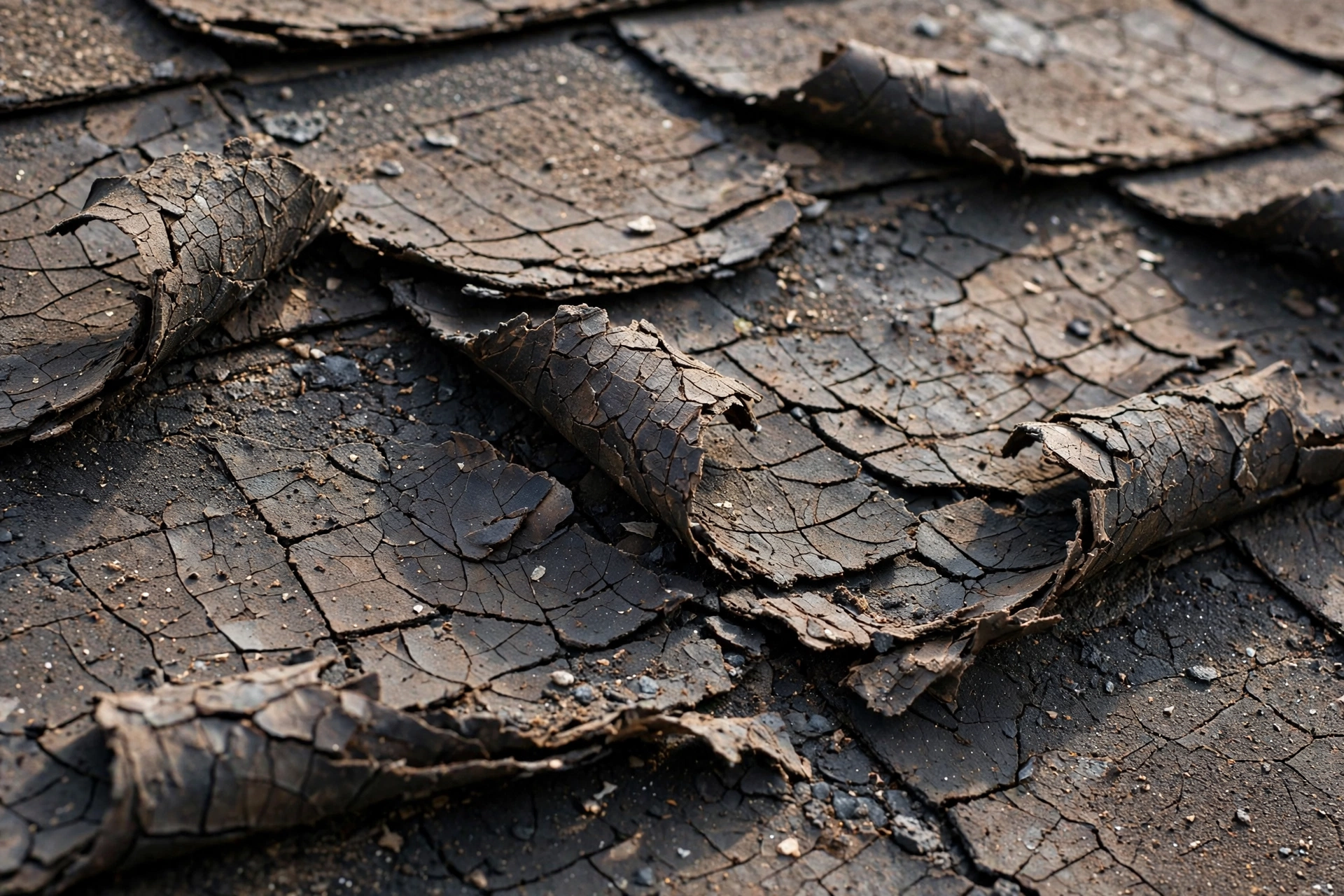
Heat-shrinkage deforms shingles in recognizable patterns. Cupping curls the edges upward like a bowl. Clawing, sometimes called fish-mouthing, lifts the center while edges stay nailed down. Both expose the shingle below to wind uplift and create channels where wind-driven monsoon rain travels uphill under the course above.
You can spot both from the ground with binoculars on a sunny day; the shadows make the deformation obvious. Isolated curling on a south or west slope, which takes the worst sun, is common and worth monitoring. Widespread curling across multiple slopes means the asphalt has aged out, and repairs become whack-a-mole: fixing one section does not stop the next from curling.
Sign 3: Cracked or Missing Shingles After Storms
After every major monsoon, do a ground-level walk-around. Look for shingles in the yard, bare patches on slopes, and shingles flipped upward. Thermal-aged shingles turn brittle, so a microburst that a young roof shrugs off can snap a 22-year-old shingle cleanly.
A few missing shingles after a storm is a repair job, not a replacement trigger, provided the surrounding shingles are still pliable. The test a roofer uses: gently lift a neighboring shingle tab. If it flexes without cracking, the field is still serviceable and a repair makes sense. If tabs snap like crackers, the roof is telling you its age all at once.
Real talk: do not go up on a brittle roof to "just check." Every footstep on heat-aged shingles cracks more of them. Ground-level binoculars and a professional inspection are cheaper than the damage from a well-meaning climb.
Sign 4: Interior Stains and What They Mean
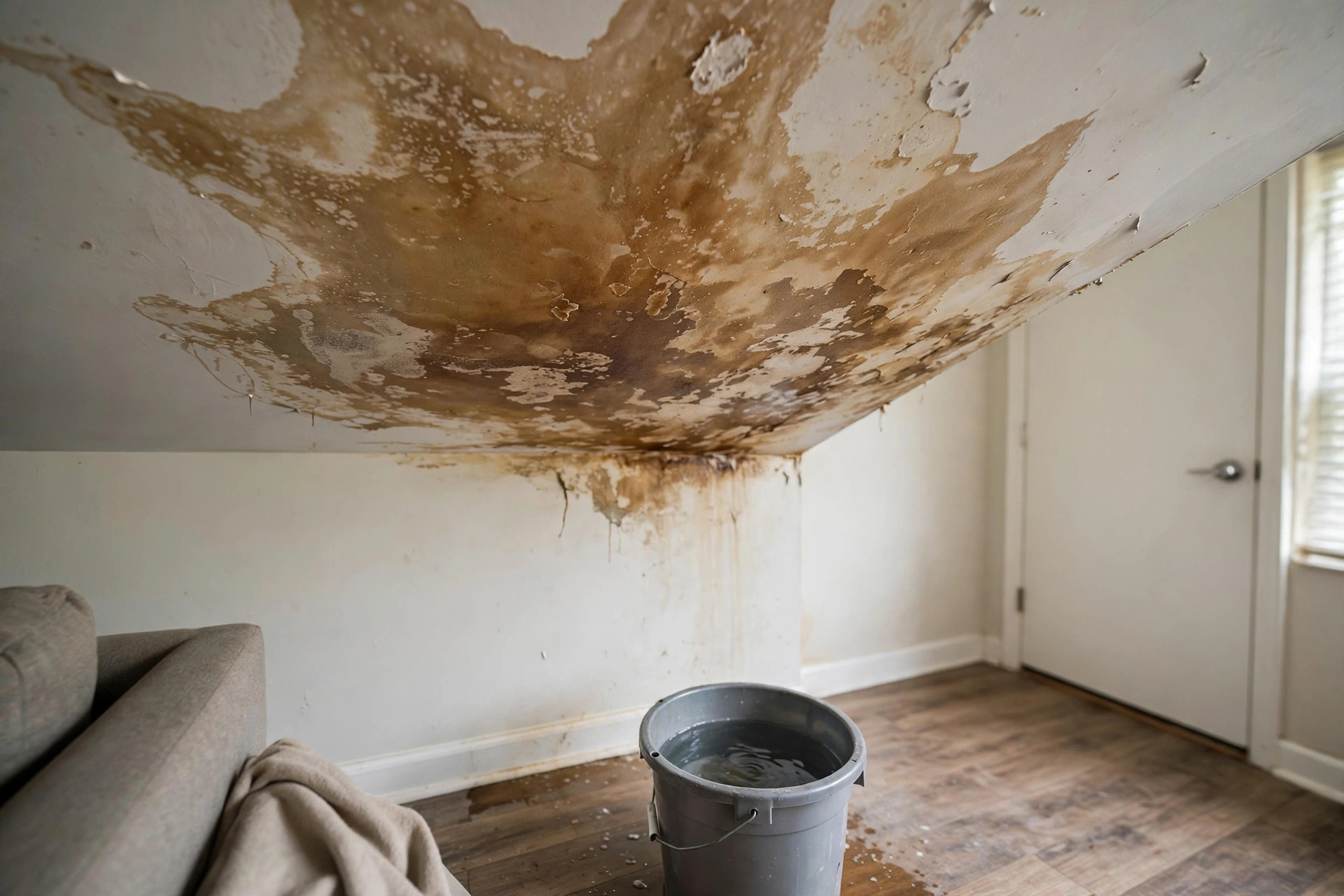
Water stains on ceilings or walls are the symptom most homeowners notice first, and the stain's location often misleads. Water travels along rafters and decking before it drips, so a stain in the hallway may originate from a flashing failure ten feet away on the roof. Do not assume the leak is directly above the stain.
Fresh stains are yellowish-brown with defined edges; old ones fade and may grow mold. Either way, the troubleshooting order is the same: check the attic during daylight and look for pinpricks of light (nail pops or gaps), damp insulation, and darkened wood. Then check the roof's usual suspects from the ground: flashing around vents and chimneys, valley lines, and anywhere a satellite dish or solar mount penetrates the roof. Flashing failures cause more Arizona leaks than field shingle failures.
Sign 5: Sagging, Soft Spots, and Daylight in the Attic
These are the signs that end the troubleshooting phase immediately. A visibly sagging roofline, a spongy feel underfoot (for the professional who goes up), or daylight visible through the deck in the attic means structural or decking damage, not a shingle problem. Long-term slow leaks rot decking from the inside, and Arizona's dry climate can hide the damage until it is extensive.
If you see any of these, stop diagnosing and get a professional inspection promptly. Decking replacement is straightforward when caught early and expensive when a section fails. This is also the point where repair-versus-replace math usually tips toward replacement, because the deck work requires removing the roofing anyway.
Sign 6: Moss, Algae Streaks, and What They Signal Here
Dark algae streaks are mostly cosmetic in Arizona's dry climate, unlike in humid regions where moss holds moisture against shingles. Still, streaks trap a thin film of moisture and heat, and on north-facing slopes with shade they can persist. Zinc or copper strips near the ridge inhibit regrowth.
More important is what streaks sometimes hide: the same shaded, slower-drying areas are where sealant strips fail first and where installers sometimes cut flashing corners. Treat streaks as a reminder to inspect, not as damage itself.
The Homeowner's Safe Inspection Checklist
You can gather real diagnostic information without ever leaving the ground. Twice a year, spring and fall, plus after every major monsoon, walk your home's perimeter with binoculars and note: missing or displaced shingles, curling or cupping patterns, damaged or rusted flashing around vents and chimneys, granule piles at downspout exits, and debris packed in valleys. Inside, check the attic for daylight, damp insulation, and stains, and scan ceilings for new discoloration.
Write down what you see with dates, and take phone photos from the same spots each time. That dated record is genuinely useful: it shows a contractor the progression, and if storm damage is involved, it documents the before-and-after for insurance purposes.
What not to do: do not pressure-wash shingles (it strips granules), do not caulk over flashing as a permanent fix (it traps water behind the patch), and do not nail down curled shingles (the nail holes become new leak paths). Temporary tarps are fine for emergencies; improvised permanent repairs usually are not.
Repair or Replace: Making the Call
The industry rule of thumb: when a repair exceeds roughly 25 to 30 percent of replacement cost and the roof is past about 75 percent of its expected life, replacement usually wins. In Arizona terms, a $3,000 repair on a 22-year-old shingle roof with widespread curling is money spent delaying the inevitable. The same $3,000 on a 10-year-old roof with isolated storm damage is money well spent.
Ask any estimator for the roof's remaining useful life in writing. That single number organizes the whole decision. Under five years of honest remaining life, put repair money toward replacement quotes instead. Over ten, repair with confidence. Between five and ten, get the repair quote and the replacement quote side by side and compare cost per year.
Real talk: be skeptical of any "free inspection" that concludes within minutes that you need a full replacement, especially from a door-knocker after a storm. A real diagnosis takes time on the roof and in the attic, and an honest roofer will sometimes tell you that you need a $400 repair, not a $14,000 roof.
What a Good Professional Inspection Includes
When you do call a roofer, know what thorough looks like. A proper inspection covers the roof surface (shingle condition, flashing, valleys, penetrations), the attic (deck condition, ventilation, insulation, daylight), and the home's exterior drainage (gutters, downspouts, grading). It ends with photos and a written summary, not a verbal "looks okay."
Expect to pay a modest fee for an inspection-only visit, or get it bundled with an estimate. Either is fine. What matters is documentation: photos of problem areas, measurements, and specific recommendations with pricing. Vague verbal assurances are not an inspection report.
Monsoon Season: Emergency Triage
When a storm hits and water is coming in, the priority order is: protect the interior (buckets, tarps over furniture, move electronics), then stop the water (a properly secured exterior tarp over the damaged area, weighted or nailed at the edges beyond the damage), then document (dated photos of interior and exterior damage for insurance), then call.
Do not go on the roof during or immediately after a storm. Wet shingles are slick, wind gusts follow the main cell, and lightning lingers. Interior triage first, roof work when it is dry and daylight. Emergency tarping services exist precisely so homeowners do not have to climb up at midnight.
After the emergency passes, resist permanent decisions made under stress. Get the tarp secured, then get two or three written estimates for the actual repair in normal working conditions. Storm-season premium pricing is real, but a tarped roof buys you the time to bid properly.
Troubleshooting by Leak Location
Where water shows up narrows the suspect list considerably. Work through these patterns before assuming the whole roof is done.
Stains around a chimney or vent pipe almost always mean flashing failure. Step flashing and counter-flashing expand and contract at different rates than masonry, opening hairline gaps over years of thermal cycling. The fix is flashing repair or replacement, not new shingles, and it is one of the most routine service calls in the Valley. If a contractor quotes a full replacement for a chimney flashing leak on an otherwise healthy 12-year-old roof, get a second opinion.
Stains along a valley line point to valley wear. Valleys carry concentrated water flow, and in Arizona they also collect debris that holds moisture against the shingles. Woven, closed-cut, and open metal valleys each fail differently, but the diagnostic is the same: heavy granule loss or visible wear in the valley channel while surrounding field shingles look fine means a valley rebuild, a targeted repair, not a roof replacement.
Stains near skylights are usually failed skylight flashing kits or deteriorated seals, especially on older plastic-dome skylights that craze in UV. The skylight itself may need replacement along with its flashing. This is a common upsell area: make sure the quote separates skylight replacement cost from roofing work so you can see what is what.
Stains at exterior walls where a patio cover or addition meets the house suggest failed headwall flashing. Additions are notorious for this because the tie-in flashing is only as good as the crew that installed it, and many patio covers were added by contractors who were not roofers. The repair involves removing the bottom courses above the tie-in and installing proper step and counter-flashing.
Widespread random stains with no pattern on an old roof usually mean the field shingles have simply aged out across the board. When there is no single suspect and the roof is past 20 years, the troubleshooting phase is over and the estimating phase begins.
The Attic Tells the Truth: A Room-by-Room Diagnostic
The attic is the most underused diagnostic space in the house. Go up during daylight with a bright flashlight and work methodically. First, turn the flashlight off and look for daylight pinpricks through the deck; each one is a nail pop, gap, or penetration that water can follow. Mark their positions relative to the stain below.
Next, with the light on, inspect the underside of the decking for dark streaks running downhill from a high point. Water leaves a trail, and the trail's top end is near the entry point. Press suspect wood gently with a screwdriver; sound decking resists, while rotted decking gives easily. Note any areas where insulation is compressed, discolored, or matted down, which indicates repeated wetting even if it feels dry today.
Check ventilation while you are there. Blocked soffit vents, often buried under blown insulation, cook the deck from below and void shingle warranties that require minimum ventilation. Baffles keeping insulation back from the eaves are a five-dollar fix for a thousand-dollar problem. Also look for bathroom exhaust fans venting into the attic instead of outside; the moisture they dump accelerates deck deterioration and grows mold on the sheathing.
Bring your phone and photograph everything, including the areas that look fine. A dated set of attic photos is the single most persuasive thing you can show a contractor, because it separates "I think there's a stain" from "here is the water path, documented."
Documenting Damage for Insurance Claims
If a monsoon caused the damage, documentation quality directly affects your claim outcome. Start the day you notice the problem: photograph interior stains with a newspaper or phone screen showing the date in frame, photograph the exterior damage from the ground, and keep every receipt for emergency mitigation like tarping or water extraction. Insurers expect you to mitigate further damage; they do not expect you to have fixed the roof before the adjuster arrives.
Do not authorize permanent repairs before the adjuster inspects, but do authorize emergency measures to stop active water entry. There is an important distinction, and your policy's "duties after loss" section describes it. When the adjuster comes, walk the property with them and share your dated photos. Adjusters handle dozens of claims after a storm; the homeowner with organized documentation gets the careful look.
Understand your deductible and your policy's roof provisions before filing. Some Arizona policies now carry separate wind/hail deductibles as a percentage of dwelling coverage rather than a flat dollar amount. A $4,000 repair against a 2 percent wind deductible on a $400,000 dwelling ($8,000) is not a claim at all. Filing claims that pay nothing still creates a claims history, so do the arithmetic first.
Frequently Asked Questions
How do I know if my shingle roof needs replacing or just repairs?
Consider the roof's age, the extent of damage, and the repair cost relative to replacement. If the roof is past about 75 percent of its expected life in Arizona (roughly 15-plus years for shingles) and damage is widespread rather than isolated, replacement is usually the better value. Isolated storm damage on a younger roof is a repair.
Can I inspect my own roof safely?
Yes, from the ground and the attic. Use binoculars for the roof surface and check the attic for daylight, damp insulation, and stains. Avoid walking on heat-aged shingles, which crack underfoot, and never go up during or right after a storm.
What causes shingles to curl in Arizona?
Prolonged UV exposure and thermal cycling shrink the asphalt unevenly, curling edges upward (cupping) or lifting centers (clawing). It is a normal aging pattern in desert heat and signals the shingles are nearing the end of their service life when widespread.
How long do asphalt shingles last in Phoenix?
Quality architectural shingles realistically last 18 to 25 years in Phoenix's UV exposure, below their 25 to 30 year manufacturer ratings. Builder-grade shingles last less. Ventilation, color, and installation quality all shift the number.
Will homeowners insurance cover my roof leak?
Insurance typically covers sudden damage like monsoon wind tearing off shingles, minus your deductible. It does not cover leaks from age, wear, or neglected maintenance. Document damage with dated photos and know your deductible before filing.
What should I do first when I find a ceiling stain?
Check the attic for active dampness and the source area, place a container to catch drips, and photograph everything with dates. Then arrange a professional inspection. Do not assume the leak is directly above the stain, since water travels along framing before dripping.
References
Asphalt Roofing Manufacturers Association. (n.d.). Residential asphalt roofing. https://www.asphaltroofing.org/
National Weather Service. (n.d.). Phoenix climate normals and records. https://www.weather.gov/psr/
U.S. Department of Energy. (n.d.). Cool roofs. https://www.energy.gov/energysaver/cool-roofs
Insurance Information Institute. (n.d.). Homeowners insurance and roofing. https://www.iii.org/
How Shingle Roofs Are Different on North-Facing vs South-Facing Slopes
Not every part of a shingle roof ages at the same rate. South and west-facing slopes take the most direct, sustained sun exposure across an Arizona day, and typically show granule loss, curling, and cracking earlier than north-facing sections of the same roof. This is why an inspection checking only the most visible or accessible slope can miss meaningful wear developing on the more exposed side, and it's part of why a thorough check covers the entire roof surface rather than a quick look from one vantage point.
The Role of Attic Ventilation in Shingle Lifespan
Poor attic ventilation compounds heat stress on shingle roofing from underneath, not just from direct sun exposure on top. A hot, poorly ventilated attic radiates heat back up into the shingle from below, effectively cooking the material from both directions simultaneously. Homes with inadequate attic ventilation often show accelerated shingle wear compared to otherwise identical homes with proper airflow, which is worth considering as a contributing factor if a shingle roof is wearing faster than its age alone would suggest.
What Happens During a Proper Shingle Inspection
A thorough shingle inspection involves more than a visual scan from the ground. It includes physically walking accessible sections of the roof, checking granule adhesion by close inspection rather than assumption, examining flashing at every penetration point (chimneys, vents, skylights) since these areas often fail before the shingle field itself does, and checking valleys specifically, where water concentration during storms creates more wear than flat sections of the roof see.
When Storm Damage Complicates the Picture
A shingle roof already showing gradual wear signs can have that wear accelerated significantly by a single severe monsoon event. Wind that wouldn't damage a newer, healthier roof can tear loose shingles that were already weakened by UV exposure and heat cycling. This is part of why post-storm inspection matters even for roofs that seemed stable before a storm hit, since existing wear and new storm stress compound each other in ways that aren't always obvious without a proper look.
A Failing Shingle Roof: Repair vs Replace
A repair genuinely holds when: damage is isolated to a specific section, the rest of the roof shows reasonable remaining life, and matching shingle is available for a spot fix.
Replacement becomes the honest recommendation when: wear is spread broadly across the roof rather than concentrated in one area, the roof has already had multiple prior repairs, or the roof is old enough that continued patching is likely to become a recurring cost rather than a one-time fix, a pattern worth recognizing before it repeats a third or fourth time.
Deck condition underneath the shingle also matters, and it's only visible once shingle is pulled back during inspection or repair, which is part of why a physical look matters more than guessing from visible symptoms alone. A homeowner assessing their own roof from the ground or even from a ladder simply can't see this detail, no matter how carefully they look.
What to Do If You're Seeing These Signs
If you're seeing any of the signs above, a free inspection confirms whether a shingle roof is actually failing or just showing normal wear, checking granule condition, curling, cracking extent, and deck condition where accessible, then giving you an honest recommendation with photos rather than a default push toward replacement. If a repair genuinely holds, that's what we recommend. If the wear pattern points toward replacement, we'll show you specifically why, section by section, rather than a general statement about the roof's overall age.
Granule Loss: What It Means and How to Check For It
Granule loss is one of the more misunderstood signs of a failing shingle roof, partly because a small amount of granule loss is completely normal, especially on a newer roof shedding loose manufacturing granules during its first year or two. The distinction that matters is whether granule loss is scattered and minor versus concentrated and progressive. Check gutters and the base of downspouts after a rain for accumulated granules, and if you're seeing a consistent, ongoing buildup rather than a one-time flush of loose granules, that points to active degradation of the shingle's protective surface. From the ground or with binoculars, look for shingles that appear noticeably darker or shinier in patches compared to surrounding areas, which often indicates the asphalt layer is exposed where granules have worn away, leaving that section more vulnerable to UV damage and accelerated aging than the rest of the roof.
How Long You Realistically Have Once These Signs Appear
Homeowners often want a specific number once they've spotted a warning sign, and while we can't give a precise countdown without seeing the roof, the general pattern is that early signs, minor granule loss, a few curling shingle edges, isolated cracking, typically mean months to a couple of years of reasonable service life remain if addressed with appropriate repairs and monitoring. Mid-stage signs, widespread curling, multiple areas of exposed asphalt, visible daylight through decking in the attic, usually mean a replacement decision should be made within the coming year rather than deferred indefinitely. Late-stage signs, active leaking, missing shingles in multiple areas, soft or spongy decking, mean the roof has likely already failed in a meaningful sense and continued delay increases the risk of interior damage substantially. An inspection gives you a specific answer for your specific roof rather than a general rule of thumb, which is why we'd rather look at it directly than have a homeowner guess based on symptoms alone.
Frequently Asked Questions
How long do shingle roofs actually last in Arizona compared to the manufacturer rating?
Standard shingle rated for 12 to 20 years nationally often shows real-world Arizona wear toward the shorter end of that range, given the intensity of local UV exposure and heat cycling.
Can I tell if my shingle roof is failing just by looking from the ground?
Some signs, like visible curling or obvious bald spots, are sometimes visible from ground level, though granule loss in gutters and deck condition require a closer look to assess accurately.
Does shingle color affect how fast it wears in Arizona?
Yes. Lighter, more reflective shingle products tend to show less heat-related stress over time than dark traditional shingle, worth considering if you're planning a replacement.
Is it normal to see some granule loss every year?
Yes, a small amount is normal shingle aging. The concern is a heavy or sudden increase, which signals accelerated wear rather than typical gradual shedding.
Does the direction my roof faces affect how fast shingle wears?
Yes. South and west-facing slopes take more direct sun exposure across an Arizona day and typically show wear earlier than north-facing sections of the same roof.
Can poor attic ventilation affect shingle lifespan?
Yes, meaningfully. A hot, poorly ventilated attic radiates heat back into shingle from underneath, compounding the UV and heat stress it already faces from direct sun exposure above.
Should I get my shingle roof checked after every monsoon storm, even if it looked fine before?
Yes. Existing gradual wear and new storm stress compound each other, and a roof that seemed stable before a severe storm can show new, storm-accelerated damage that's worth catching promptly.
Get a Failing Shingle Roof Checked, Free
Free inspection, honest findings on whether it's a repair or genuinely time to replace.
[Call Now]
Free inspection · Licensed & insured · Serving Phoenix and the Valley
Roof Questions? One Call.
Free inspection, honest answer, no pressure either way.
Call 1-(844) 640-5335